Making Mistakes and Moving Forward

Learning through failure is now a staple trope of progressive pedagogy, yet it remains one of the hardest elements to install into our classrooms and our own lives. Within academia, at least in the academic spheres I’ve been party to, the stakes are high, failures are very costly, and individuals are scared to step beyond the set parameters of societal and personal expectations.

Failures, however, are par for the course, and more than simply being scared to try new things, our attitude toward failure impedes our ability to reflect on and learn from mishaps in any meaningful way, or perhaps, it prevents us from capitalizing on the unintended consequences. Sometimes ‘mistakes’ turn out to be great opportunities. Cloaked in shame, fear, disappointment, and even rejection, it makes sense that our first reaction would be to deflect responsibility, divert attention, or simply deny the realities of our mistakes. I am imploring my students to think of failures differently, and I have several assigned readings on the topic, including Scott Adams’ How to Fail at Almost Everything and Still Win Big, but this is not enough. I have to lead the way by modeling the attitudes and behavior that I want my students to adopt and that I believe will benefit them in the long run. The following is my reflection on a mistake that I have made recently.

In August 2016 I started a new job teaching a subject I love at a large university in a fabulous city. I moved away from my family to a new country for an opportunity that I believed was too good to pass up.  I have only been teaching in university for a couple of years as an adjunct, and the learning curve has been steep. (Notice how we always need to contextualize our situation to soften the perceived accountability of our impending actions. Not that there’s anything wrong with this, as I believe most of our mistakes happen purely out of lack of experience and not on account of sinister intentions, but it seems to me to highlight the enormity of the fear surrounding failure.) I was hired to teach Interdisciplinary Studies, an area with which I am intimately familiar and that I believe should be the bedrock of education for the contemporary world. Interdisciplinary Studies focuses on the necessity of addressing complex problems that demand creative, innovative, adventurous, and unconventional thinkers. A whole program dedicated to fostering these qualities was/is a dream come true for me.

But here’s where I went wrong (this of course is not the only mistake I’ve made, but I think it’s the most significant in this context). I know what interdisciplinarity involves, so I thought I knew what an interdisciplinary student would be like, and I set out to build my courses accordingly. Here are a couple places where this mistake was most prominent.

Self-Direction

The Interdisciplinary Studies program requires students to set out their own course of study according to their goals and interests, and so I thought these students were highly self-motivated and self-directed. For the most part, however, they are not, and I would argue that it’s largely not their fault. For many, the unfortunate reality is that this is a degree of last resort (I say “unfortunate” because I believe that if students really understood power and promise of Interdisciplinary Studies it would be their first choice), and many are shouldering the scars of rejection by and failure in a consilience of systems in which the deck has been largely stacked against them. I have learned a lot about the education system that has produced these students, and like most traditional education systems, the rules are set and rigidly enforced. Not only have students not been given opportunity to develop capacity for self-direction, they have been bludgeoned by a culture of conformity through aggressive systems designed for successful test-taking and quantitative assessments. Their grammar is impeccable, but their originality is abysmal.

I used to construct my assignments with an intentional vagueness with the goal being to provide enough structure to guide students through the assignment while maintaining enough openness to allow students to bring their own voices to bear. I regret that the vagueness of my assignments may have caused panic–not what I intended, of course. Taking their feedback very seriously, I made a few changes: I now provide much more explicit instructions in terms of structure and more detailed prompts. For example, I state how many paragraphs I expect to see written, and what specific questions they might explore. I encourage students to simply write more. I believe that simply writing more facilitates an intentional stance towards moving beyond prescribed perspectives and ‘correct’ answers. I put very little weight on writing mechanics, and in fact, instead of adopting a punitive stance for writing errors, I have started giving students an opportunity to revise for full credit. I believe that removing focus from the writing mechanics to the content will install a necessary degree of freedom (besides, their writing has already been policed enough in other courses and previous education). I am contemplating including a journaling component with prompts in the next iteration of my courses.

I want my classroom to be a safe space for students to ‘try on’ different perspectives and to gain the confidence to explore their own minds without repercussion. This semester, I have largely avoided lectures and have moved to games and exercises as the primary delivery mode, but not all of the students are comfortable with this. There is safety in the familiar, but I’m not convinced that the familiar is in their best interest. I am contemplating the question as to how I can promote self-direction and self-motivation in ways that allow students to explore and fail safely. As always, suggestions and feedback are very welcome.

Enthusiasm

Interdisciplinary Studies promotes problem-based learning–complex problems–to be specific. According to The World Economic Forum, the ability to address complex problems is the most in-demand job skill in the contemporary economy, and the complex problems that are being tackled by the intellectual forces of our global society are both awesome and inspiring. I am so excited for my students–they are on the cusp of stepping into this revolutionary world at an amazing moment in human-natural history. How cool is that? I expected students in the Interdisciplinary Studies program would be animated and enthusiastic, but instead I have found a heavy and relentless apathy. My mistake has been to spend more time bemoaning apathy than cultivating empathy.

Students have good reasons for apathy, I’ve discovered after many long conversations with them and others. Many, if not most, are facing a depleted job market with huge debts that will follow them for the remainder of their lives. I’ve learned that debt-forgiveness programs are few and far between and the repercussions of not being able to repay loans can be severe. I’ve noticed that many students are working long hours for low wages to try to reduce the chains of debt. I’ve noticed that many of my students talk about their marriages, children and spouses even though they seem rather young still (they volunteer such info in class discussions, for example. I would never ask students about this). It appears that many get married and start families at a young age for a number of reasons, some perhaps related to cultural/religious beliefs, and perhaps some related to the realities of financial pressures in regards to healthcare and living expenses. Whatever the reasons, the added pressures of work and family life during the completion of a university degree surely contributes to a dampened enthusiasm.

I am still struggling with how to address this problem. The one thing that I know for sure is that I do not want to be complicit in the systems that exacerbate the problem; yet I fear that in my course structure I may have implemented the very types of authoritarian policies that these systems espouse. I have strict deadline policies, for example, and (usually) an attendance policy. I want to empower my students not deplete them any further, but I am scared of being perceived by the governing bodies as being too ‘soft’, not being academic or rigorous enough, or simply not making my students work hard enough. Interdisciplinary Studies in particular has been plagued with these very types of critiques. Whose side am I on? I want to be fair yet sensitive to my students’ needs while maintaining the integrity of the institution. Part of the problem is that the academic institutional structure is out of touch with the realities of the demands of the new economy. Creativity is the new conformity, and new frameworks for academic standards and values are desperately needed. Faculty should not be in the position of having to ‘choose’ between the best interests of their students and the demands of institutional protocol–but this is and will continue to change. In the meantime, what do I do?

One thing that I have been trying is to encourage students to think about what projects/issues/topics they find inspiring and focus on figuring out how they contribute to those as a means of finding meaningful work. In other words, I ask them to think about what they they want to work on  as opposed to what work they want to do. I have been curating and showing videos and talks that might inspire them and I am actively working to bring in guest speakers from various fields. I would like to have more individual conversations with students about their own goals and aspirations, and I am making an effort towards this end, but with four classes each semester, it’s a bit difficult. And, most importantly, I am rethinking every class policy I have adopted. I am going to do things differently. I am keeping my eyes peeled for ideas and suggestions.

From now on, I will approach my students with a much more open mind. I will seek to learn about who they are and attempt to make my courses responsive to their specific needs, rather than seek to impose my ideas of who I think they should be. I will admit that an authoritarian stance is in many ways easier, but it feels terrible and it’s absolutely no fun.
Teaching Interdisciplinarity

While I have been teaching in post-secondary settings for several years now, I have not before taught Interdisciplinary Studies explicitly, until this year. My current teaching load includes two Cornerstone and two Capstone courses. The cornerstone courses are designed to furnish students with a foundation in the theories, concepts, and methods pertinent to doing interdisciplinary work, and to provide resources for students to plan their educational path according to their interests and future goals. The Capstone courses focus more on providing tools for students to convey their degrees in cohesive ways as they move into the next stages of their lives.

As I approach the end of my second semester, I have identified a couple of key issues that are hampering my teaching efforts and that I am seeking to address in the future iterations of my courses.

1. Student Apathy. For some reason, no matter what we are discussing, my students only occasionally look up from their silenced screens and stare at me with with flat looks of aggressive disinterest when I pose questions to the class. I’ve asked students directly why this is so, and the answer has been a range of things: the topic is uninspiring, they’re tired from their exhaustive schedules, not applicable to real-life issues, too early in the day, too late in the day, too complicated, too simplistic. I have to admit a great deal of frustration. I can’t sing and I can’t dance.

So, what’s left? How am I addressing this issue? Well, I am exploring several avenues. First, I’ve been asking everyone I meet with teaching experience how they address this issue, and I’ve received lots of great feedback and ideas that I am trying out. More interactive technology, more peer-to-peer learning, gamification, dealing with real-world issues, addressing controversial issues, and I am learning to sing and dance. Second, I am delving into the research and talking to the teaching and learning experts. Perhaps there are some systemic issues unrelated to the mode of delivery that are propelling apathy. Third, I continue to ask the students directly. What is wrong? What can I do to inspire enthusiasm? Lastly, I am keeping notes on what I learn so that when I do find answers, I will have an idea where they came from and how to reproduce them.

2. The Nature of Interdisciplinarity. I am an avid consumer of Interdisciplinary Studies literature. It is one of my main areas of research and interest, and the only thing I can say almost for sure is that despite the best efforts of professional interdisciplinary associations, among others, an understanding of the constitution of interdisciplinarity is, well, ethereal, for lack of a better word. Textbooks have been written, theories proposed and disposed of, examples and samples produced, yet descriptions and definitions beyond the superficial notion of combining multiple perspectives are disjointed.


In some ways, this disjointedness is a boon because it allows interdisciplinarity to be widely adapted throughout a plethora of academic contexts, but with such a disparate understanding and application, what are we supposed to teach students?There are a few key textbooks that have been adopted in many IDS programs, and these are the textbooks that I have been using as well. What I have noticed, however, is that the content of these textbooks is largely detached and irrelevant to what students are actually doing and what they need to know. (I know this statement needs much more clarification, but that will take another entire post, which I am working on.)

What I mean is that students are not, for the most part, doing disciplinary-based research. They are, often, just trying to get a degree to get a job. They don’t seem to care about the formal structures of academia or their knowledge repositories, and rightfully so, to some extent. We are in the Google era where unmanageable amounts of information are at our finger tips and sly algorithms feed us what we want to hear to re-affirm what we already think. This is no time to be teaching content–at least not in Interdisciplinary Studies–at least I don’t think so.

So, I am struggling with determining what exactly it is that students need. They seem to want a utility-based education, and I agree that that is what they need, though we do not agree on the the nature of this ‘utility’. I don’t think that the students really understand what the market is demanding, and I don’t think that the university (generally speaking, of course), in its traditional formulation, is able to deliver what the world needs, at least not effectively, if at all.

The world seems to be screaming for a creativity, as Daniel Pink and Mark Cuban, among many others, have been saying for some time, but the traditional academy is a fine-tuned highly effective technology of conformity. Students, I believe, need to learn, or perhaps re-learn, creativity, but this process will demand that they leave their comfort zones and challenge their by-now-deeply-ingrained propensity to simply get it ‘right’. Furthermore, the university will need to create space for an entirely different way of doing knowledge. Cue interdisciplinarity.

I agree with the basic notion popular in the literature that interdisciplinarity is a creative process, and more specifically, I agree with William Newell’s argument that complexity theory provides the appropriate framework for interdisciplinarity (though of course my academic credibility hinges on the disclaimer that there are numerous aspects of his argument that compel challenge). Complexity theory is essentially a theory of creativity, but translating these insights into practice is proving more difficult than I expected.

So, what am I doing to address this problem? I am looking at other models of ‘teaching’ creativity. I’m trying different exercises, and looking for patterns that I can identify and replicate. And, after a long sabbatical, I am returning to the complexity and education literature. I am going back to the basics. I’m starting simple: connection, interaction, feedback, non-linearity, and emergence. These are the elements of complexity and interdisciplinarity. They are not content to be conveyed but experiences to be fostered. I believe that this is what students need, but I could use some help figuring out how to foster these experiences effectively. And how to make them like it.

The Problem and the Problems with the Problem–Notes on Chapter One

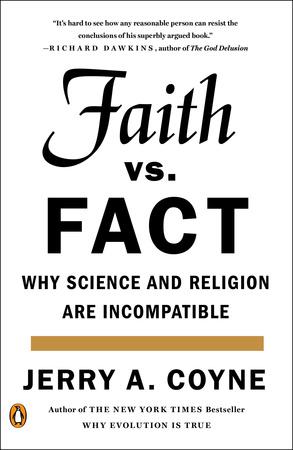
9780143108269Jerry Coyne’s recent book could not have come at a better time. The science-religion debate is out of control.

In the first chapter of this book, Coyne lays out the problem: the notion that science and religion are compatible is detrimentally influential and widespread despite overwhelming and mounting evidence that the two are irredeemably at odds and despite the plethora of contradictory argumentation for the compatibility thesis.

Why is this problem a problem?

In the preface, Coyne notes that his personal interest in this topic relates to the difficulties he has faced in trying to persuade others in the validity of evolution, both as a teacher and author of a well-known pro-evolution anti-creationist book Why Evolution is True. Noting the rather small conversion (or de-conversion, depending on one’s perspective) of his audience given the abundance of empirical evidence, Coyne is moved to consider this issue from a more abstract level—science versus religion. Religious claims about the natural world amount to hypotheses that are being answered in pseudo-scientific terms, and he notes that “religious people were staking their very lives and futures on evidence that wouldn’t come close to, say, the kind of data the U.S. government requires before approving a new drug for depression” (xv). Furthermore, Coyne asserts that accepting the compatibility thesis dilutes science and renders it impotent. Thus, Coyne’s work seeks, in an odd way, to protect religious believers (though I doubt he would phrase it quite this way), and, more importantly, to protect science and its affordances as a natural knowledge enterprise.

There are at least two problems with the problem as identified by Coyne.

On page 22 Coyne hints to some of the implications of accepting a religious worldview that is not based on the types of truths offered by a rigorous and reliable science. He suggests that accepting religious truth claims implies accepting the social and moral imperatives wherewith they are packaged, including the relentless control of sexuality and social order. This element gets only a passing reference in this chapter, and he promises to develop this further in the next. I agree with Coyne on this assertion, but I think its role as a key driver in the compatibility debate is understated, to say the least.

The second problem, and one that I hope to explore more thoroughly, is that Coyne, as with other authors of the same ilk, assume that somehow science is automatically a better truth generator in regards to claims upon which social and moral parameters can be grounded.

Of course science is a far superior method of generating truths about the natural world, but the realities of how science gets done does not reflect the idealized truth-generating rigorous science that is generally assumed.

Take, for example, the unending science proclaiming the inexorable distinctions between males and females. Every day I see that science is showing how men’s brains are different from women’s brains, how men sleep differently from women, how men drive differently from women, and on and on. Such science, though likely showing some truthful elements, blackens out the ways in which the genders are the same, or the statistical range of similarities. Such studies emphasize a distinction that hides overlaps and contributes to an ethos in which gender segregation is understandable and sensible. All those who fall outside of these norms are instantly pathologized, and this gets translated into a whole host of scientifically-sanctioned social injustices. Now many will argue and say that such representations of science are a product of a pathologically-gender-obsessed media. And while certainly this is a big part of the issue, the selection of research questions produces the types of results that the media wants to report.

This discussion is taking Coyne’s work far beyond what he has written in this first chapter, but it points to larger issues just under the surface of this debate. The point that I want to bring to the fore is that science, like religion (and I am not a big fan of religion), are tools that can be manipulated in multifarious ways. Science is not automatically apolitical, and it is the political dimension of this debate that I think is of the most interest and significance.

Trust in…Whom?

Over the last few weeks in Halifax, Nova Scotia, Situating Science has presented two installments in the national lecture series “The Lives of Evidence.”  On February 28, Carl Elliot from the University of Minnesota gave a talk entitled “An Atypical Suicide: Psychiatric Research Abuse at the University of Minnesota.” In this talk, Dr. Elliot told the story of Dan Markingson, a young man who committed suicide while involved in a clinical trial of an anti-psychotic drug at the University of Minnesota. Dr. Elliot is pushing for a thorough investigation into this case as he alleges research misconduct in the university’s psychiatry department. With several pieces of evidence from Markingson’s records, Elliot alleges that, among other things, Dan Markingson was enrolled at a time when his refusal to do so might have resulted in physical confinement due to his psychological instability, and that his consent was procured just days after several assessments from different examiners determined that Markingson was unable to make his own medical decisions. Elliot is seeking to raise awareness of the issues specific to this case and research ethics more generally.

On March 5, Scott Findlay from the University of Ottawa gave a talk entitled “Governing in the Dark: Evidence, Accountability and the Future of Canadian Science.” Findlay stressed the essential role of government-supported science by arguing that government has both the infrastructure and responsibility to conduct science in the public interest. Science in the public interest, Findlay argued, should service public values—healthy minds, bodies, and environment, and it should provide an evidentiary basis upon which laws and policies should be built. Findlay cited several examples of the current Canadian government’s initiatives to claw back funding for scientific research, enact policies that ignore strong but conflicting evidence, and hamper and silence government scientists by prohibiting communication with the public and between the scientists themselves.  Findlay did not linger on the question as to why the government has moved so far in this direction, but he urged his audience to become active in this issue as a matter of guarding a keystone of democracy.

In regards to these talks, there are two points I want to make. The first one is about money and morality and the second one is about confusion and evidence.

Elliot’s talk made it very clear that he suspects money to be a primary driver of misconduct. In the Markingson story, the doctors running the trial and the university’s teaching hospital where the trial was being conducted both profited handsomely from Markingson’s participation in this study. Furthermore, it appears that policies and procedures were manipulated to secure Markingson’s participation and protect researchers from conflict of interest allegations. Findlay did not grant much attention as to the driver of the Canadian government’s anti-evidence stance, but it has been stated elsewhere that the government is motivated by the enticement of wealth from the extraction of natural resources, and evidence that interferes with this objective is systematically downplayed, distorted, and/or dismissed.

The impacts of such motivations are severe. Markingson’s suicide happened on campus and was particularly gruesome. The impeding of environmental science and action by the Canadian government has many researchers worried about the catastrophic effects of climate change and environmental degradation, not just on human populations, but on the sustainability of life in general. So what I cannot help but wonder is whether, or perhaps why, money seems to negate morality. What kind of evolutionary purpose is there in this? Or it is simply an ugly byproduct?

Part of the answer to my question may lie in a small but perceptible fault-line between these two presentations. On one hand, Elliot challenged his audience to challenge the evidence—the scientists and the science from which the evidence comes. On the other hand, Findlay challenged his audience to challenge the challenging of evidence. This is not to suggest that Findlay in any way endorsed a blind-faith acceptance of scientific evidence, but he did encourage at least a contingent acceptance. Contingent, that is, on the development of alternative or convincing contradictory evidence.

Confused yet? I am. I don’t trust government-endorsed science right now. I don’t trust corporate-endorsed science right now. And I’m not sure I trust the academy-endorsed science right now. And if I go to the heart of these talks, I should probably not trust people in general.  Apparently money negates morality. Or does it?

The whole Occam’s razor approach to these types of questions always leaves me skeptical. I find it hard to accept that the answer is so simple, and I have trouble believing that people are so susceptible to the seductions of money and power. Are people so easily transformed into cold-hearted immoral agents of ill-will at the prospect of gaining more money in their pockets? Am I? While individuals like that undoubtedly exist, I don’t believe that people in general are like that. Certainly there must be some who have resisted such enticements, and the fact that Elliot is appealing to our sense of justice to become outraged at this story suggests that there are many who would indeed resist. Likewise, in the case of the government’s anti-environmentalist pursuits surely there are some in this contingent that, given a scenario that they could believe and accept, would forgo profits for the sake of the sustaining and flourishing of life. So why does money negate morality for some and not others?

I don’t have a good answer. All I have at this point is a thought, but it’s corny. I am not a fan of the democratization of science in the sense that I do not like the idea of scientific discoveries being vetted in terms of acceptance or rejection by the general public. Let the scientists do what they do; however, I am a fan of personalizing science. I would like to see the personal side of scientists more, particularly when it comes to understanding the results of their research. Scott Findlay spoke of ways in which scientists could get more involved in public discourse of values and best practices without necessarily becoming partisan advocates and jeopardizing the objectivity in their work (to the extent that such objectivity exists, Findlay said, and I agree). I am more apt to trust someone I know or think I know and understand, even if I disagree with his or her ideals.

Sure, I do not trust the current Canadian government’s science, but I’m quite sure there are many people in the government who I would trust. The Harper government has been very astute at isolating itself from the media and carefully controlling its public image. It’s unsettling to see such a cultivated picture, and this does nothing to bolster trust–quite the opposite I’d say. I do not trust corporate science, but again, I’m quite sure there are many within such organizations that I would trust. You get the point. If we can shift our focus from the scientific machinery to the people, we may be able to wade through the confusion and find some trustworthy guidance. The funny part is that deciding where to invest our trust in science may end up being more of a gut-reaction rather than an evidence-based decision.

The War on Science and its Secular Cloak

Recently I’ve been reading The War on Science  by Chris Turner. Turner chronicles the Harper government’s steady dismantling of Canada’s environmental science infrastructure and the instantiation of anti-environmentalism into public policy. Turner documents Harper’s apparent insistence on thwarting environmental research and erecting barriers between evidence and policy.  Turner places his critique in an historical context that positions Harper as an enemy of science and a problem politician to the extent that what we formerly considered political scars now look like beauty marks. I’m exaggerating, of course, but I’m referring to the actions of Mulroney that left the country in financial despair and whose party was virtually demolished at the end of his parliamentary tenure. Mulroney, according to Turner, at least sought evidence-informed intervention in the problem of acid rain signaling an interest in the well-being of the country and its inhabitants.  If Mulroney and Harper are going to be compared, however, I’d like to point out another dissimilarity—under Harper, the country’s financial state cannot, arguably, be characterized in terms of despair.

According to Turner, Harper’s agenda is quite straight forward (loc 404 Kindle ed.): “Do No Science, Hear No Science, Speak No Science” — that is the Harper agenda. And if this agenda is most evident and most pronounced in environmental science, that is simply because it is the field most likely to uncover evidence that the government’s paramount goal — to free the country’s resource extraction industries from regulatory oversight in the name of rapid expansion — is wrongheaded, reckless, and damaging.”

Twice Turner quotes environmental scientist David Schindler’s comments about the deep cuts of Bill C-38: “The kindest thing I can say is that these people don’t know enough about science to know the value of what they are cutting” (361 and 1415).

I don’t dispute this author’s presentation of the data nor do I dispute his interpretation or analysis—that can be left up to others more qualified than me. My problem with this book draws on a point I made in an earlier post but now want to expand on here.

While I understand and appreciate Turner’s obvious frustration and outrage, I am not convinced of the picture he paints of the Harper government. Is it really the case that all of those powerful government officials are so uneducated, stupid, naive, silly, evil, stubborn, greedy, or whatever ill-characterization we might choose? Moreover, what do we make of those who elected them, repeatedly, not to mention those — such as the scientists, academics and generally concerned citizens—who have had little success in intervening to change Harper’s direction?

I do not think that the Harper government’s narrative is that simple. While he and his government have thus far taken a most obvious anti-environmentalist stance, there are more clues to be found as to some other things that might be going on and that might be connected to this war.

In 2010 Marci MacDonald published The Armageddon Factor: The Rise of Christian Nationalism in Canada. In this book, MacDonald offers another framework from which to understand some of the Harper government’s activities. She suggests that the Harper government is working in step with Canada’s Christian-right faction that seeks to instantiate its biblical ideology, couched in an end-times prophetic narrative, into the public mind and policy. In terms of Harper’s anti-environmentalism, this narrative makes more sense, though it too has some major gaps.

Just to give a couple of easy examples:  The Christian-right has the propensity to take the Bible quite literally (or quasi-literally I would argue), so it’s not such a leap for those operating in such a framework to interpret the declining environmental state as a sign of the end times and not the natural outcome of human behavior and activity (e.g., Luke 21:11: 11 — “There will be great earthquakes, famines and pestilences in various places, and fearful events and great signs from heaven” [NIV]).   Or, there’s the view that God has given man dominion over the Earth and, apparently, the economy it facilitates, and good stewardship is manifested and rewarded by the bearing of abundant fruits (yes, the metaphors are a study onto themselves).

MacDonald’s framework is not a good enough answer either, however. There are indeed many movements afoot within the sphere of the Christian-right that advocate for careful environmental stewardship, are strongly concerned with the impact of environmental degradation on the poor, and disavow profits-at-all cost ambitions. Moreover, one might argue that there remains an acute environmental apathy within the Canadian culture more generally that is unassociated with religious beliefs whatsoever. The Liberals had had a robust environmental agenda as a key element of their platform in previous elections, but they lost rather dramatically. This is not a simple story and we cannot blame everything on one particular ideological orientation at work in our political culture.

My point(s) is(are) simple: there is much work to be done!! We cannot continue to talk about Harper’s “War on Science” without talking about the religious orientations of our elected officials to the extent that such orientations guide and/or influence public policy decisions. In a paper presented to the Canadian Political Science Association at Concordia in 2010, Jonathon Malloy makes some important and relevant points. Drawing on direct interviews with evangelical MPs he writes that “most self-identified evangelicals do not emphasize the building of separate and parallel ‘Christian’ institutions, but emphasize some variation of actions as ‘salt and light’ (see Matthew 5) within existing institutions” (pg 6). Furthermore, he writes, “evangelicals commonly argue that their faith does not necessarily determine their views on specific issues. Rather, it is a sense that their faith underlies their entire character and outlook, and particularly their personal integrity” (pg12).

Many of us may well look at the beliefs and assertions of religious groups and think to ourselves or aloud “This is crazy. Ridiculous.” But it is also ridiculous to simply write off a government and its public associates as irrational, stupid, and greedy particularly when this group, or at least subsections of this group, takes great pains to operate with a high degree of integrity. And I believe they are sincere. It seems easier for us to believe that people are greedy and evil, but such judgment seems to me to fall smack-dab in the center of the same religious framework that we are assailing. We take the narrative of good and evil without question, and so if Harper and his people are simply evil than we need a different religious narrative—one that offers some type of salvation to both the earth and its inhabitants. In this narrative we are coerced into seeking a new savior—one that will save the government from itself. “Forgive them–they know not what they do.”

The insistence of a secular cloak on politics is probably one of the greatest boons to those seeking to impose religious ideology into the public sphere. It forces people to seek and develop ways to quietly embed personal faith and beliefs into public pursuits thus it turns our attention away from the messiness of personal faith and beliefs onto the concise little policy outcomes to which they give rise. It also traps those seeking recourse into the easy narratives of profit and greed or whacko conspirators seeking to rule the world for some god to explain what is happening and why we can’t seem to do much about it. These are copouts.  The secular cloak seems to have truly partitioned off a sacred ground and granted it license to foster mystery and mystique—not a platform for democracy that I would embrace. And while Canada presents its ideally partitioned church-state profile to the world, the beliefs and ideas of the Christian-right, who or whatever this is or whatever it really means in Canada, are being carefully and cleanly translated into public policy and practices.

There is certainly a growing body of scholarship on the Christian-right in Canada, but we need more–more nuanced and just more, particularly in regards to science, policy and the general intellectual/academic milieu. We usually associate the political influence of the Christian-right with American politics, but while the US factions parade their worldview on Fox News for the world to cheer, challenge, mock or whatever one’s reaction might be, nothing much is said here in Canada. But lots is being done. It’s not a case of all talk and no action. It’s exactly the opposite.

Science, Evidence, and Narrative

Science, Evidence, and Narrative

I’ve heard it said that the way we see the world in some ways determines the world we see.  I think this is true, though I’m not well equipped to delve into this from any deep philosophical vantage point. And I don’t mean to suggest any type of supernatural causation instantiated via the human gaze. All I am attempting to query here is the role of narrative in perception. Well, not simply perception, maybe “knowledge construction,” but I’m not sure what the right terminology is for the idea I seek to explore.

Let’s start with this: There seems to be a great deal of positive talk about use of narrative to communicate science. I found one Scientific American blogger, Bora Zivkovic, who sketches a narrative methodology for science communicators and provides a short typology: “cool stories” play on the sense of oddness or peculiarity in a bid to capture the curiosity of the audience; “relevant stories” seek to inspire some sort of behavior or action; and “fishy stories” look into the workings of the science and scientists themselves. These types of science narratives suggest that there is translation to be done from some pre-narrative domain to a narrative domain, or that stories are written in a way such that the ‘facts’ or the science is dragged along with a plot.

In his article “Re-calibrating the Science-Media Conversation,” Jacob Berkowitz argues that the use of narrative is a plausible way of traversing conceptual divides that hamper cross-domain communication. I’m quite confident that he is spot-on in this, though perhaps not in the exact way intended.

Berkowitz’s piece suggests something similar to Zivkovic when he writes that he is exploring the use of narrative in the construction of science-based theater, books and plays, but he hints at something that I think is more significant. He discusses the analogy of the iceberg in the context of cross-domain communication: “Only a small portion of an iceberg is visible above the waterline. In science communication it’s the facts that are visible above the cognitive waterline. The vast bulk of what’s actually being communicated lies invisible below the factual surface. Down there are the beliefs, histories, ideologies, personal and community relationships—all the things that actually make or break cross-cultural communication.”  What is unclear, however, is whether or not the above portion could stay afloat on its own accord. In other words, is it the case that science lays outside of the narrative domain? Or is it that it atop of all that ‘other’ noise?

The point I am trying to get at is this: I am not convinced that there is a pre-narrative domain as is suggested in the narrative methodology of science communication. In a recent talk at the University of Saskatchewan, Cindy Patton discussed her analysis of the ways evidence is derived from studies designed to examine what appeared to be a correlation between an increase in crystal meth use and rates of HIV. She argued that the evidence was taken to instantiate, what I would call homophobic policies that amounted to the policing of non-heterosexual activity. On one level, it appears that the results of the studies that were conducted were read (even constructed, perhaps one might argue) in the narrative context of normative (compulsory) heterosexuality, a narrative that saturates virtually every cultural domain and permeates our conceptual history and heritage.  Seeing differently takes education and adaptation—though I’m not sure in which order. Either way, it seems that we need to investigate the narratives that shape and house our discoveries and insights as much as or more than we need to translate them into second level stories (though I’m quite sure this is a very good thing in and of itself).

Perhaps we need to dig into our narratives at an even more basic level. Lakoff and Johnson (1980/2008) suggest that our basic means of operating within the world is primarily metaphorical. Our conceptual practices structure “what we perceive, how we get around in the world, and how we relate to other people. Our conceptual system thus plays a central role in defining our everyday realities” (3). These authors argue that experiences and interactions provide the basis for the development of conceptual metaphors, the transference of experience and interactions with the material/physical world, or source domains, into ideas and concepts–conceptual or target domains, and these become systematized into more comprehensive frameworks. Looking more closely at these frameworks may be one way of digging into the narratives that are embedded in the presumed pre-narrative perceptual domain.

What does this have to do with communicating science?  Well, let’s see. I have serious doubts, for example, that there is any type of story, play, book, or theater production that will convince a Christian creationist of the validity of evolutionary science. However, maybe, if we look at the differing narratives and the conceptual metaphors that structure them, we may find patterns that are common to multiple domains. Metaphors that convey concepts of group belonging, in/out metaphors, for example. Or perhaps we will find common ontological metaphors that invest ethereal concepts and ideas with material properties and thus facilitate certainty and security that functions to ward off the paralysis of fear and doubt. It may be that these basic conceptual metaphors furnish a cohesive narrative that shapes perception and can be drawn on to proffer the ‘spirit’ of science and discovery rather than the ‘facts’ themselves.

Of course, this leads us onto a slippery slope which may in the end leave the whole point moot anyway. If what I am suggesting has merit we are going to find ourselves having to face the ethics of narrative manipulation. [i1]  I think we first need to face the deep entanglement of science and narrative that already seems to have us knotted and twisted in all sorts of weird and wacky contortions. Of course, while we debate these ethics, our narratives are already being expertly manipulated by scientific discourse and competing narrators that want us to utilize all sorts of paraphernalia that we had no idea existed and didn’t realize we desperately needed.

Paradigms. Worldviews. Conceptual frameworks. Cultures. Ideologies. Perspectives. Ways of knowing. Call it what you will, but it seems to me that we see the world through the lens or lenses of certain full-bodied cognitive sets. One could have all the evidence in the world, but when it butts up against an impenetrable embedded narrative, acceptance becomes difficult. Remember OJ? A tight glove and a cute little rhyme to challenge what seems so obvious could very well be enough to let the guilty walk free. But is this the same for scientific evidence? Must observable reality be vetted through accepted networks of perceptual pathways? I think so. It’s messy but surely it’s part and parcel of what we do. We need science and story, but though they may be parsed at a literary level, I think that at a more basic level they are one and the same.


Evidence, the Death of Evidence, and Finding Some Good Questions

The recent announcement by the Canadian Federal government of the closing and consolidation of Fisheries and Oceans libraries has the media, once again, reporting outrage on what appears to be the present government’s war on science. A quiet outrage has developed among academics and researchers as they mourn the loss of priceless data and artifacts.

I call the response a “quiet outrage” because I’m not certain that their concerns are resonating with the general public. One blogger, for example, listed the number of shares of a couple of related media bits, and in my mind, the numbers are quite low.

So what I want to point out is that it seems to me that headlines that assert the Harper government’s row with “science” dilutes and obscures an important point: the Harper government seems to be waging a war on one particular type of science—environmental. Which, I’m quite sure everyone knows. So why not say “environmental science” specifically instead of “science” in general?

Recent media makes little mention of the meaning and reasoning behind these seemingly strategic moves. The few suggestions that appear or are hinted at are basic and typical: profits, especially given Canada’s place in the global market of fossil fuels, and it will be handy to have a bunch of money to hand out just prior to the next election.

But I don’t think it’s that easy. The picture that is painted with such explanations are that of a bunch of greedy cutthroat irrational people conspiring to gain and lord power just for the hell of it and in the face of obvious and imminent demise. Maybe. But I doubt it. Call me sentimental or naive, but I kind of feel that most people tend to be mostly decent and will do a good thing if they can. Of course determining what’s  “good” is based on one’s frame of reference.

I recently attended a symposium about science and society. The foundational question of this symposium was this: “How can we understand and improve the interplay between science and society, and improve science policies for the future?”  Throughout the symposium, and at a number of recent events along similar lines, several recurrent themes have popped up:  citizen science, science and democracy, and trust in science. “Evidence-based policy” and “evidence-based decision making” seem to be the catch-phrases du jour. But there was not a peep about religion. At least not that reached my ears, and I thought I was listening pretty close.

Are we thus to assume that civilizations are now witnessing the pinnacle of  advancement  such that church and state, faith and science are properly quarantined to their respective corners? I am highly skeptical.

In regards to the Canadian federal government’s war on “science” (read: environmentalism or environment or environmentalists), some writers have offered an alternative explanation: Harper and his government are motivated by an evangelical Christian worldview that holds God and his natural law-infused ecological order and balance responsible for the ultimate fate of the earth.  In this view, if this is indeed the case, then it seems that the environment is not a human issue but a divine one.

I am not sure how accurate such claims are, and in fact I don’t really know why the Harper government seems so bent on thwarting environmental science. But I think we need to take a closer look. The news articles themselves say little to nothing about what’s behind the anti-science activities it reports. Few seem to want to bring it up.

I know this is a difficult issue. The media persecutes any misstep towards religious insensitivity or intolerance more harshly than it does Harper’s activities. The academy is no better—everyone seems scared to offend, to cause a scene or infringe on one’s personal and private realm of thought and belief.  I know that this is a volatile issue. There are lots of easy arguments about who’s right and who’s wrong, and no one wants to wake this sleeping dragon.

But if we’re going to talk about evidence, we need to talk about conceptual frameworks. Evidence, obvious or not, is context contingent, and if we want to talk about science and the general public, or science and public policy, or science and public officials, we need to talk about science and its place in the marketplace of competing ideas, thoughts, beliefs, and conceptual frameworks.

What role is religion playing at the interface between science and its publics? (And by “religion” I mean the good old fashioned monotheistic types, replete with their own worldviews, moral systems and evangelistic ambitions, fuzzy as these descriptors might be, at least to start with.) I’m not sure what the consensus is or even what the spectrum of opinion is, but the silence seems to be its own brand of a death-of-evidence.

We accuse the government of killing evidence, of turning a blind eye to the obvious and well- documented. But what is that old saying? The one about being concerned with a speck of dust in another’s eye without noticing the stick in one’s own? Maybe I’m wrong, or maybe I’m just not looking in the right places. I am not sure. But for now, I care more about the questions than I do about the answers. In fact, let’s forget about the answers altogether for the moment and just start looking for some good questions.

Hype in Science: How can respectable journals publish such c**p? oh, and peer-review

On December 7, 2013, the Atlantic Node of Situating Science Strategic Knowledge Cluster hosted a one day public series of discussions exploring six case studies of overselling, misrepresentation or biasing in the presentation of scientific research. Included in these case studies was a discussion of the NASA supported research article published in Science that claimed the discovery of bacteria from arsenic that was subsequently refuted; a discussion of the widely popular and controversial “Liberation Therapy” for MS; and a discussion of what appears to be a contemporary re-inscription of racism in the new science of cognitive genetics. Each of the discussions evoked lively debate and conversation.

Let me start my comments by saying that I am by no means and in no way a scientist. I struggle with basic arithmetic and can never remember what gold is on that chemical thingy (what do you call that?…Oh yeah, the periodic table!! That’s it). The point being that I cannot be trusted to relay any of the theoretical content of the discussions, though I have to admit, the conversations were largely accessible, even to the scientifically challenged. There were, however, several themes that arose throughout the day that concerned the interaction between science the general public, and I am going to focus on one of them now and will return to the others in later posts. Now I am not an expert on the “general public”, whatever that actually is, but as I am not a scientist, I feel that I somehow belong that exo-scientific constellation and I speak from that situated location.

So I hear that the peer-review process is in crises. Now, I am not sure if all would agree with my assessment that the discussions portrayed such a dire situation, but that’s the way it seemed to me. In her presentation “The “Arseniclife” Debacle,” Rosie Redfield (UBC) discussed an article in Science that reported the existence of arsenic-based bacteria. After this research was published it was subject to intense critique and was subsequently refuted based on a number of outstanding problems (don’t ask me what they were, I didn’t get it and I don’t know).  Dr. Redfield led the audience in questioning how such major scientific problems in this, a NASA-supported research project, could have made its way through the series of checks and balances that have been traditionally trusted to safeguard against this very thing. While certainly the peer-review was not the only culprit (and indeed Dr. Redfield suggested other factors that were likely of greater consequence), the starkness of the error is outstanding.

So what’s the problem with peer-review? Well, nothing new here. Writers want readers, sellers want buyers, and everyone wants something new and exciting. Sometimes reviewers are selected based on their known sympathies for the subject of the pending paper, some reviewers are swayed by academic charisma of the research being presented, and sometimes even the pool of potential reviewers is assembled based on political prospects rather than on academic credentials and expertise. I’m sure there are many more reasons why this process is problematic, and I hope readers will bring me up to speed on all the other pitfalls, but the point is that the word on the street is this: Houston, we do indeed have a problem!

What struck me as particularly interesting is the way in which the conversation oscillated between how essential the peer-review process is and how problematic it is. If the issues are as severe as I heard, why not just abandon the whole thing? This reminds of the problem with marriage—it fails somewhere between 40-60 percent of the time (depending who you ask), and these stats do not even include those who may remain married even though they are miserable or those who remain married even though the partners are practically living separately. Yet everyone just keeps doing it, over and over. Abandon the whole idea? What? Society would crumble! Abandon peer review? The science sky would surely fall.

In my own research, I’ve recently been considering a legal case in the US in which the court was trying to sort out the scientific status (and legal status though it seemed that the legal status was secondary) of intelligent design. In this case, one scientist made the argument that science is as close as it comes to a universal language, and that the peer-review process is the essence of this language. ID is not considered science by most scientists because, among other things, its practitioners do not participate in traditional peer-review research forums (though ID advocates have built up a network of their own journals, conferences, etc).  But if the peer-review process is what keeps ID ‘science’ at bay, and peer-review is not really working well, then I, the general publican in the room, am nervous.

I wonder if it is not really the peer-review process itself that enraptures scientists but the ideal of peer-review. Scientists, to me, often seem to deal in prestige and credibility, and so it’s perhaps not the impact of peer-review on knowledge claims that is so important but rather the impact on the credibility of knowledge claimers. Perhaps the greatest value of peer-review is that it marks validation and acceptance into a selective social sphere entailing rights and privileges that diminish as the boundaries become more porous. If this is indeed the case, then it’s the presence not the practice of peer-review that really matters, and little wonder scientists are not really interested in seeing it abolished (I have a fun parallel argument for [or against, actually] marriage, but alas I must save it for another time and place).

I am actually not being cynical here at all. As a wary watcher of alternative religious ‘science,’ particularly those alternatives that are widely endorsed by a large proportion of the ‘general public,’ I am nervous about the democratization of science for lots of reasons. But on the other hand, this democratization has to a large extent already taken place. This was spectacularly evident in the presentation by Dr. Murray on “Liberation Therapy” for MS. Dr. Murray discussed how this therapy was widely endorsed and taken up by members of the general public and even the mainstream medical community despite a significant lack of evidence for its effectiveness and a good deal of evidence for its potential harmfulness.  People want to and do judge for themselves, and the governing bodies can easily find themselves at the mercy of great public pressure.

The main point that I want to make here is this: If scientists want to revamp the peer-review process, it might be more effective to be clear about what it is they are dealing with. Is it a process of knowledge adjudication, a process of knower adjudication, or both? That much of the conversation at this event focused on protecting/improving knowledge and knowledge claims seemed to me to be a shill for protecting the power and prestige of the scientific community (and the trustworthiness of science by extension), and there’s nothing wrong with that (at least not for me so long as it works to keep a rein on the political powers of pseudo-scientific initiatives, but this is a huge topic for another time). The task is made cumbersome by the tacit cloak of epistemic value. I have no idea whether or not good science can be done without peer-review, but I think that a lot of good science gets done in spite of it.

Citizens and Science: Really?

On Monday, October 21, 2013, Dr. Yves Gingras (UQAM) opened the Science and Society Sympoium 2013 with a talk entitled “The Transformations in the Relations between Science, Policy and Citizens.” Humorous and insightful, Dr. Gingras inspired a great deal of conversation and set the tone for a very productive three days that focused on how to improve the social-science interface. I begin here with an overview of the presentation which is followed by a short commentary.

Dr. Gingras began with a light-speed tour of the relatively recent emergence of what he calls “The New Science Contract.” Though by no means the first major shift in the in the relations between science policy and citizens, contemporary shifts in the landscape mark a return to a type of public science from a type of private science that had come to pass, in part, on account of the rise of instrumentation and sophistication of science that increasingly required specialized knowledge and skills. In many practical ways, these developments largely barred the layperson from participating in the scientific enterprise and established an obvious partition between science and the citizen.

Things are now very different and changing rapidly. With the burgeoning of the digital realm throughout all the nooks and crannies of the social world, not only have the ways in which knowledge is produced and disseminated changed, so too have the relationships between knowledge and knowledge practitioners. With a perpetual vetting of knowledge through public media forums, easy access to a wealth of knowledge repositories online, an increase of public interest in the impact of science (such as in the realm of environmental issues or medical interventions, for examples), “the doctor knows best” is no longer the powerful governing sentiment that it once was.

Dr. Gingras contrasted two models of the relationship between citizens and science. One model, the older more traditional model, entails a fairly linear chain of command, so to speak: citizens elect representatives who then articulate the government’s priorities in science and in turn entrust these priorities to the major funding agencies that then administer the dispersion of funds to specific research and technology development activities.  The newer model is much more web-like in that citizens now have representation not only by elected representatives but also by lobbyists and special interest groups. Citizens now have more direct access to the major funding bodies and elected officials can and do now intervene directly in research activities. Dr. Gingras presented a number of specific cases to demonstrate each of these relational developments. Fueled by better and more rapid access to knowledge, a more educated population, an ease in the organization and operations of special interest groups, and a competitive industry that transacts in science and knowledge claims, among other things, one might say that science has reached the end of normal and has been transposed into a post-normal realm.

An erosion of trust in research and truth claims is a central issue in the new scientific ethos. Who do we trust? What claims are reliable? As Dr. Gingras explained, it often does not take much digging under surface, particularly the highly publicized claims, to discover the beneficiaries. One finds that a fair number of good scientific initiatives and developments attract big industry and are harnessed to (and perhaps driven by) the industry’s economic objectives. The blogosphere is rife with campaigns for and against everything from vaccinations to caffeine, and these campaigns entail the embedding of arguments in the perceived power of scientific authority.  Who knows who or what to believe.

Okay, I think I understand the problem, and I am in no position to make a case for or against either of models, to echo Dr. Gingras.  Each, I am sure, have their advantages and drawbacks. A quick look around attests to the rapid evolution of science and technology which suggests that the older model has been working to some degree at least. One question I have, however, is whether or not the older model as articulated by Dr. Gingras represents how the relationship between science and citizens really worked or represents the conception or perhaps perception of how it worked.

This makes a difference because if it is a model of how the science actually worked (or works), then the term “citizens” functions as a rather unified homogeneous unit which washes over the distribution of power and influence at play within such a collective. In other words, if this is how science actually worked, then “citizens” renders the vision of a unit in which all members are equal with equivalent power and influence. Everyone gets one vote. In reality, political stratification is and has been a reality.

Indeed, the traditional model might well be understood as highly receptive to special interest groups in a way similar to that of the contemporary model, except that the number of groups are far fewer and unmarked. The special interest group(s) are those situated in the dominant realms of the “citizen” collective and can wield the power and influence that their position affords to access the processes of science at points conducive to their own agenda and objectives.

While there may indeed be special interest groups in the traditional model that are consciously organized and understood in the same way as they are understood in the contemporary model of science, I am more interested in pointing out the rather un(officially)organized and likely even unconscious interest groups that seem to have shaped the science-citizen relationship in significant ways. For example, feminist theorists have pointed to the ways in which science has long embodied androcentric values and norms. One result of this was (is), as Carla Fehr discussed in a separate talk at this symposium, a lengthy history of sharp misrepresentations of gender and sex, systemic mis-observations and disinterest in relevant and significant information. As Fehr explained, it’s not necessarily that scientists and knowledge practitioners were (are) necessarily ‘bad’ at what they did or that they had disingenuous intentions. More significantly, the science entailed the values and norms of the social context in which they developed. As a result, the interests of those citizens whose interests correspond with androcentric norms and values are taken up in the scientific process, at all points of possible entry. Though unnamed and unmarked as a special interest group in the way in which they are currently understood, and perhaps not even really fitting within the framework of this term at all, there seems to be a degree of commensurability in that one group of citizens among others had more (perhaps tacit but at least concentrated) access, influence, and impact on the scientific enterprise. Similar arguments could be made if one looked from the perspective of class, race, sexual orientation, and so on.

There is much worry about the erosion of trust inherent in the new network science model. But I wonder if the discomfort is really about a lack of reliability (or perceived lack) of science and scientific claims or about the transfer of power/influence from a concentration in dominant social factions to a dispersed and sprawling web of diverse people with diverse interests.

I don’t think, however, that a more democratic type of science in itself (whatever ‘democratic” might actually mean other than some basic notion of distributed political power), can offer any advantages in regards to challenging biases in science. It may appear that a system in which the many rather than the few have influence on the knowledge economy and participation in the scientific enterprise is better equipped to ensure that a diversity of interests are represented, but if cultural norms and values are not attended to and still entail serious social inequalities then they will continue to infuse the same biases—en masse rather than from concentrate. What I mean is that so long as our cultural norms and values embrace, endorse, sustain and reproduce dominant ideals to the benefit of some and detriment of others (in unethical proportions) such power discrepancies, such as those articulated in the feminist critiques of science, may indeed be more democratic but may not be any less hierarchical or bias and value laden.

Indeed, it seems to me that there is a risk that the democratization of science may entrench the biases even more. It’s one thing to petition a central governing body to reconsider the implicit values and assumptions of the conceptual framework in which the relationship between citizens and science is situated, but it’s quite another to motivate collective reflexivity and undertake a mass persuasion project.

I do not have anything close to a good solution, and in fact, I am not even sure if I have sufficiently articulated problem. I do think, however, that at the very least there are a number or worthy questions.